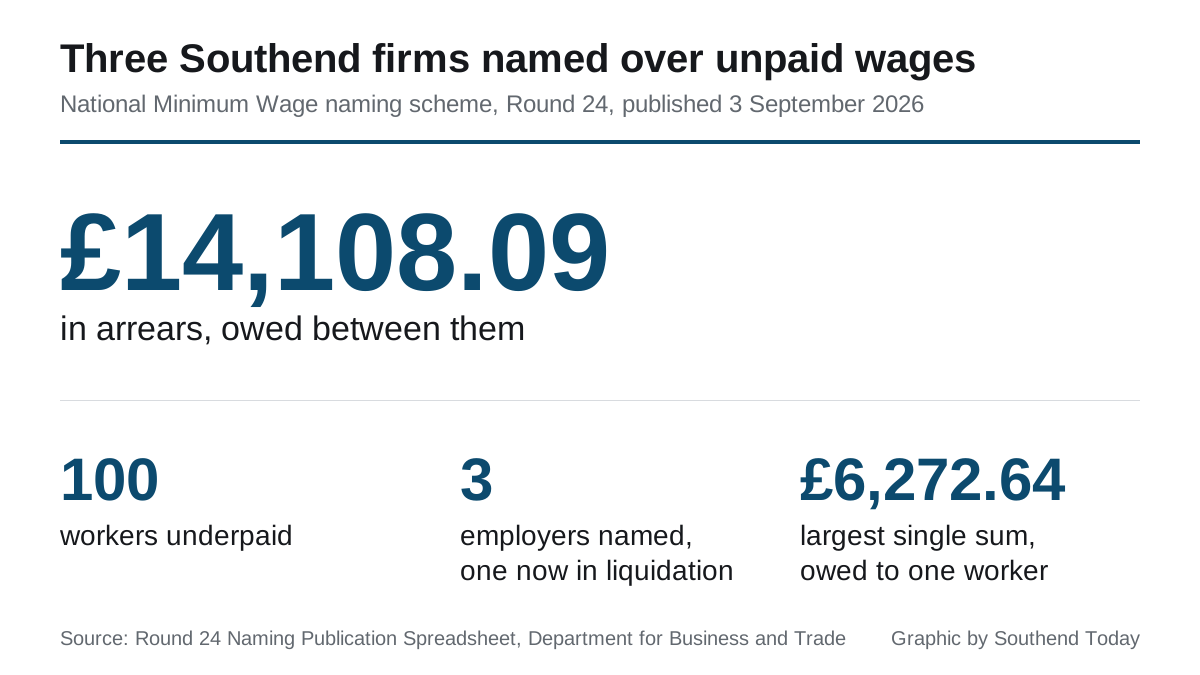

Three employers with Southend addresses underpaid 100 workers by £14,108 between them, the government's naming list shows. One is now in liquidation.
Three employers with Southend trading addresses have been named by the government for failing to pay the minimum wage. Between them they underpaid 100 workers a total of £14,108.09.
The names appear in Round 24 of the National Minimum Wage naming scheme, published on 3 September 2026. It is the first naming round since the Fair Work Agency took over enforcement in April (Department for Business and Trade).
The three Southend entries, taken from the government’s own spreadsheet, are:
- Reynolds Motor Group Service Centre Ltd, postcode area SS3, failed to pay £6,272.64 to one worker, covering 1 December 2021 to 31 August 2023.
- Ranaissance Care Ltd, postcode area SS1, failed to pay £4,314.72 to 65 workers, an average of £66.38 each, covering 3 April to 28 May 2023.
- Victoria Court Residential Home Limited, postcode area SS1, failed to pay £3,520.73 to 34 workers, an average of £103.55 each, covering 27 May 2020 to 26 March 2024.
All three figures are arrears, not fines. The penalties employers pay on top are not published per company (Round 24 naming spreadsheet).
Who the three companies are
The naming list gives only a partial postcode. The Companies House register fills in the rest.
Reynolds Motor Group Service Centre Ltd (company number 11256862) is active and registered at 42 to 46 Ness Road, Shoeburyness, SS3 9DF. It was incorporated in March 2018 and its recorded business activity is the sale of motor vehicles. Its entry on the naming list is the largest single sum owed to one worker of the three, £6,272.64 for a period of one year and nine months (Companies House).
Ranaissance Care Ltd (10046616) is in liquidation. A court order to wind the company up was filed at Companies House on 28 March 2025, and its registered office was moved to the Companies House default address in Cardiff in April 2026. Before that it was registered at 11 Nelson Street, Southend-on-Sea, SS1 1EF. Its recorded activity was other human health activities. The underpayment covers a two-month window in spring 2023, when it still traded (Companies House).
Victoria Court Residential Home Limited (04209445) is active and registered at 127 to 129 York Road, Southend-on-Sea, SS1 2DX. It has been on the register since May 2001. Its arrears period is the longest of the three, running from May 2020 to March 2024 (Companies House).
One caveat matters and the government prints it itself. The geography in the list comes from the postcode of the employer’s trading address, and the underpayment may not have happened at that address (Round 24 educational bulletin).
The national picture
658 employers across the UK were named in this round. The government says around £4 million has been returned to more than 27,000 workers, with £7 million in penalties issued to the employers responsible.
63 of the 658 are in the East of England, the fifth largest regional total. The biggest single entry nationally is B&Q Limited, based in Eastleigh, which failed to pay £456,934.72 to 4,530 workers.
Since the scheme started in 2011, the government says more than £100 million in penalties have been issued to over 5,200 employers, returning more than £66 million to 650,000 workers.
Why employers end up on this list
The educational bulletin published with the round sets out what went wrong. Some employers had more than one problem.
- 39% made deductions or reductions that took pay below the minimum wage (257 employers). The bulletin lists uniforms, parking permits and travel costs, training costs, salary sacrifice schemes including cycle to work, till shortages and clothes bought to meet a dress code.
- 34% did not pay for all the time worked (221 employers). That covers work before and after a shift, rounding clock-in times, unpaid travel time, mandatory training, and problems with final pay when someone leaves.
- 16% failed to pay the uprated minimum wage (104 employers) after the rates went up.
None of that requires an employer to have set out to underpay anyone. A staff uniform charged to a worker on the minimum wage is enough.
What happens to an employer who is caught
HM Revenue and Customs enforces the minimum wage on the Fair Work Agency’s behalf. Where an officer finds an underpayment, they can issue a notice of underpayment requiring the employer to pay arrears to each named worker.
The financial penalty on top can be up to 200% of the arrears, capped at £20,000 per worker. It is halved if the employer complies with the whole notice within 14 days. An employer can appeal a notice to an employment tribunal within 28 days of it being served (GOV.UK guidance).
What it means for you
- If you think you have been underpaid, you can check your pay through GOV.UK or complain to HMRC using the pay and work rights complaint form. Acas gives free and confidential advice on 0300 123 1100.
- Check the deductions, not just the hourly rate. On the evidence of this round, the most common cause of underpayment is money taken out of pay, not the rate printed on the contract.
- Unpaid time counts. Time spent opening up, closing down, travelling between jobs or sitting through mandatory training is working time for minimum wage purposes.
- If your former employer has gone under, arrears are a claim in the liquidation rather than something the company can simply pay. The Insolvency Service’s Redundancy Payments Service handles claims for wages owed by an insolvent employer.
The local labour market context is in our report on the Southend claimant count.
Sources
- Department for Business and Trade news release, 3 September 2026
- Round 24 Naming Publication Spreadsheet (XLSX) and the Round 24 educational bulletin (DOCX)
- Companies House records for Reynolds Motor Group Service Centre Ltd, Ranaissance Care Ltd and Victoria Court Residential Home Limited
- GOV.UK: enforcing the minimum wage
Have your say