
Southend's first taxi policy brings a points system that can cost a driver their licence, and the council says it never banned Uber. Start date still blank.
Southend’s taxi drivers have never had a single rule book. They are about to get one, and it comes with a points system.
Cabinet approved the council’s first Taxi Licensing Policy on 7 September and sent it to full council, which took it as item 13 on Monday 14 September (Cabinet agenda, Council agenda). Minutes of Monday’s meeting have not yet been published, so the formal outcome is not on the record at the time of writing.
Until now, conditions and guidance for drivers and operators have been “fragmented across multiple documents”, which the council says “can lead to inconsistencies in understanding and enforcement” (Cabinet report). The Department for Transport requires every licensing authority to have a policy. Southend did not.
It has taken a while. A first draft went to the Licensing Committee in January 2025. Consultation was approved that July. The revised version came back to committee in June 2026, which strengthened the duty on operators to report certain matters to the licensing authority before passing it on.
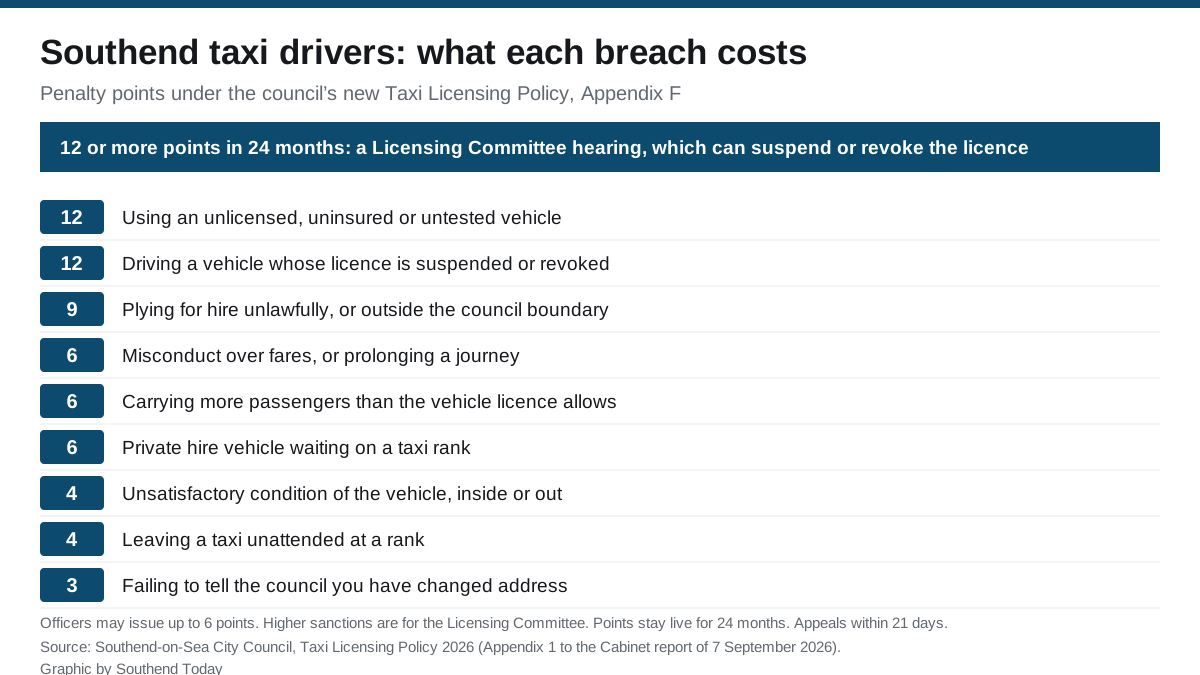
Twelve points and you are in front of the committee
The headline change for drivers is Appendix F, an in-house penalty points scheme (Taxi Licensing Policy, Appendix 1). It works much like points on a DVLA licence, and it runs alongside the council’s existing enforcement powers rather than replacing them.
How it works:
- points stay live for 24 months from the date they are issued
- 12 or more points in a rolling 24 month period means referral to the Licensing Committee, which can suspend or revoke a licence
- council officers can issue a maximum of 6 points; anything higher is for the Licensing Committee
- points must be confirmed in writing within 10 working days
- a licence holder has 21 days to appeal in writing, to be considered by a senior licensing officer
The tariff is specific. Using an unlicensed vehicle, or one without insurance or a valid MOT, is 12 points on its own. So is driving a vehicle whose licence has been suspended or revoked. Plying for hire as a private hire driver, or as a hackney carriage driver outside the council’s boundary, is 9. Misconduct over fares is 6, as is carrying more passengers than the vehicle licence allows. Failing to tell the council you have moved is 3.
The Southend Licensed Taxi Drivers Association opposed the scheme in consultation. The council’s published answer was blunt: the system exists “to encourage licence holders to comply with all legislation and licensing conditions”, and “drivers who are compliant and behave to a good standard need not fear the introduction of a points system” (responses analysis).
The council says it never banned Uber
Thirteen residents and businesses wrote in asking why the council had banned ride hailing apps. The council’s answer, on the record for the first time, is that it did not.
“There is a misconception that Southend Council either banned or refused applications from app based operators and Uber in particular. This is untrue,” the council wrote. “Any company can apply for a private hire operator’s licence and the council is legally required to determine it.”
It then went further: “An application was approved for a Private Hire Operators licence for Uber to operate in Southend but they later withdrew.”
What else is in it
- Every new hackney carriage licence will go only to a wheelchair accessible vehicle. The council has also relaxed the rule that only side entry vehicles qualified, allowing “significantly cheaper” rear door entry vehicles, in the hope of attracting more applicants. It puts the current fleet at around 18% wheelchair accessible and bookable, against an unmet demand survey finding that up to 3.4% of hires need one.
- A written off vehicle will never be licensed, whatever the category and however well repaired. A driver asked for case by case assessment and was refused.
- Euro 6 emissions standards apply to all licensed vehicles. Retrofitting engines into older vehicles is not permitted, and retrofit emissions technology must be accredited under the government’s CVRAS scheme.
- Drivers must show proficiency in spoken and written English, and the council may assess it individually.
- Outward facing dashcams are allowed under Information Commissioner’s Office guidance. If the camera also records sound, the council must be told it is fitted.
- The passenger decides on the radio. A driver asked why the policy stops him putting the radio on without permission. The council replied that “as the passenger is paying it is right that they should have the final say”.
Three things changed because someone objected. Drivers no longer have to disclose what they paid for a vehicle. The dress code was amended after a driver pointed out that hats are useful against low sun and winter weather. A typographical error in the lost property section was corrected.
Two gaps worth knowing about
The start date is blank. The version published with the Cabinet papers reads “This Policy will become effective on .....................” The full council was asked to adopt a document that does not yet say when it bites. From that date, whenever it is set, the policy “will override and supersede all existing Council policies” on taxi and private hire licensing.
Fares are not in it. Several residents asked about rates. The council’s answer is that fares sit outside this policy and go to a separate public consultation every time they change.
What it means for you
- If you use a taxi from Southend Airport, Southend’s rules may not apply. The council confirmed that the airport “falls within Rochford Council’s licensing area”. Complaints about a cab picked up there go to Rochford, not Southend.
- Complaints now have a tariff behind them. Reporting a filthy vehicle, a refused fare or an overcharged journey feeds a points total that can end a licence, rather than being handled case by case and forgotten.
- Disputes about the route are often settled by GPS. The council says it investigates complaints with an open mind and that “often GPS data will resolve disputed matters”, so report the journey promptly with the time and pick-up point.
- Nothing changes for drivers yet. The policy binds licence holders from its effective date, and that date has not been published.
- Planning a journey instead of a cab? See our guide to Southend train times to London and parking in Southend.
Sources
- Taxi Licensing Policy, Cabinet covering report, 7 September 2026, Southend-on-Sea City Council
- Appendix 1, Taxi Policy 2026 with committee amendments, Southend-on-Sea City Council
- Appendix 2, responses to the public consultation, Southend-on-Sea City Council
- Council agenda, 14 September 2026, Southend-on-Sea City Council
Have your say