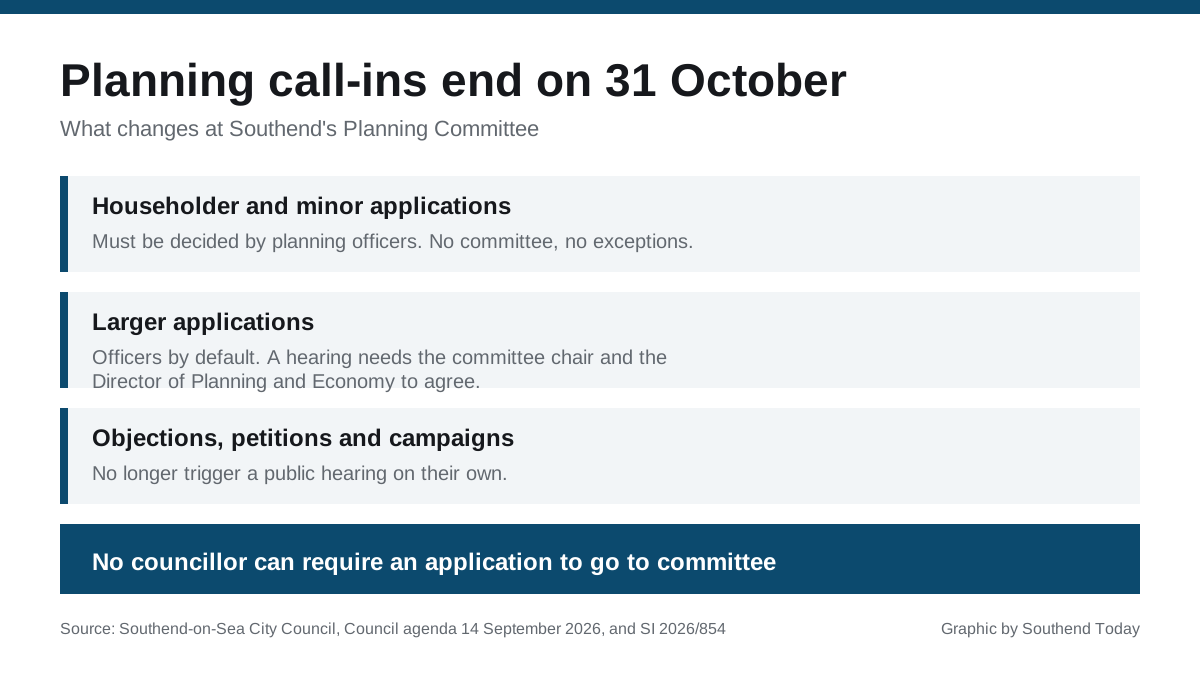

From 31 October no Southend councillor can force a planning application to a public committee. Two people will decide what gets heard. Council votes on Monday.
From 31 October, no Southend councillor will be able to force a planning application to be heard in public.
Councillors meet on Monday 14 September at 6.30pm in the Council Chamber at the Civic Centre to rewrite the parts of the constitution that currently allow it. The change itself is not optional. It is national law, and the council’s own report says failure to comply “would leave the local planning authority vulnerable to legal challenge” (Council agenda, 14 September 2026).
What the law does
The National Scheme of Delegation was created by the Planning and Infrastructure Act 2025 and is delivered through the Town and Country Planning (Discharge of Local Planning Authority Functions) (England) Regulations 2026, which come into force on 31 October (officer report to Council).
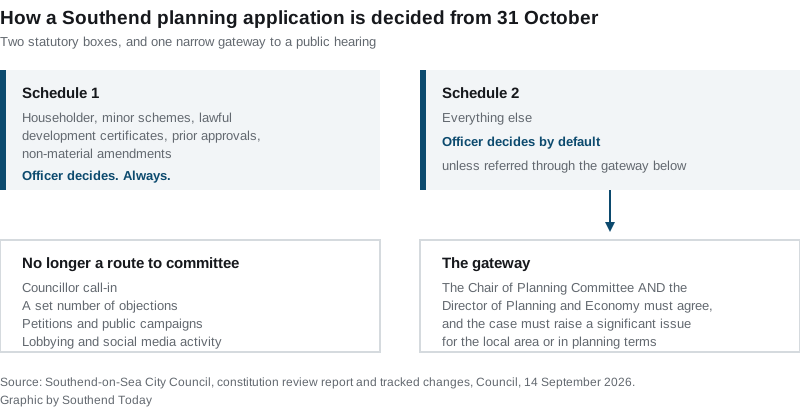
It sorts every application into two boxes:
- Schedule 1 applications must be decided by an officer. That covers householder work, minor schemes, lawful development certificates, prior approvals and non-material amendments. A committee cannot take them even if it wants to.
- Schedule 2 applications go to an officer by default. They reach the committee only where the statutory gateway is used.
The gateway is narrow. An application may be referred only where a nominated officer and a nominated member both agree, and only where it raises a significant economic, social or environmental issue for the area, or a significant planning issue.
Two people, not eleven
Southend’s draft constitution names who those two people are. The nominated officer is the Director of Planning and Economy, currently Heather Cheesbrough. The nominated member is the Chair of the Planning Committee, currently Cllr Margaret Borton, with Vice-Chair Cllr Stephen Habermel standing in where the chair cannot act.
The tracked changes to the constitution put the loss in plain words under the heading “Abolition of Local Call-In Arrangements” (Appendices 1(a) to (d), tracked changes):
- “No councillor has a right to require an application to be referred to Planning Committee.”
- “The receipt of a specified number of objections shall not trigger automatic referral to Planning Committee.”
- “Petitions, public campaigns, social media activity or lobbying shall not of themselves justify referral to Planning Committee.”
Councillors keep the right to make representations as ward members. The draft is explicit that a request for a committee hearing “shall be treated as representations only”.
The regulations also cap a determining committee at 13 members. Southend’s Planning Committee has 11, so it does not have to shrink.
How much is affected
Fourteen applications were validated in Southend in the week beginning 7 September alone, according to the council’s weekly list. The Planning Committee’s next agenda, for 16 September, carries five (Planning Committee, 16 September 2026):
- 26/00979/FUL, 28 Benvenue Avenue, Eastwood
- 26/00831/FUL and 26/00832/ADV, BT Street Hub outside 1076-1078 London Road, Leigh
- 26/00722/FUL, 114 York Road, Southend-on-Sea
- 26/00591/FUL, 48 Argyll Road, Westcliff-on-Sea
- 26/00798/FUL, 43 Woodgrange Drive, Southend-on-Sea
Most of the applications on any weekly list are householder or minor schemes. After 31 October those cannot go to committee at all.
One safeguard is added rather than removed. The council must keep a register of referral requests and decisions, record the reasons for referring or not referring, and publish it. The draft sets that at quarterly.
What it means for you
Your objection still counts, but it has to reach the officer. The number of objections no longer decides whether an application is heard in public, so the substance of what you write matters more than how many neighbours write in. Comments on live applications go through the council’s planning register, and only planning matters carry weight: overlooking, parking, highway safety, noise, design, trees, flood risk.
Asking your ward councillor still has a point, but a smaller one. They can put your case to officers and ask for referral. They cannot require it, and from 31 October no local protocol can give them that power back.
If an application does reach committee, the public speaking rules survive. An objector can address the committee and the applicant has a right of reply, under paragraphs 3.14 to 3.18 of the constitution.
Watch the referral register when it appears. It is the only public record of what was asked for and refused, and it is where you will see how narrow the new gateway is in practice.
The wider planning picture in Southend is still unsettled. The draft Local Plan was paused in August, and a separate motion on Monday’s agenda asks for a cross-party working group to oversee its return.
Sources
- Southend-on-Sea City Council, Council agenda, 14 September 2026
- Southend Constitution Review: National Scheme of Delegation, officer report
- Appendices 1(a) to (d), tracked changes to the constitution
- The Town and Country Planning (Discharge of Local Planning Authority Functions) (England) Regulations 2026
- Planning Committee membership
- Southend-on-Sea City Council corporate structure
Have your say