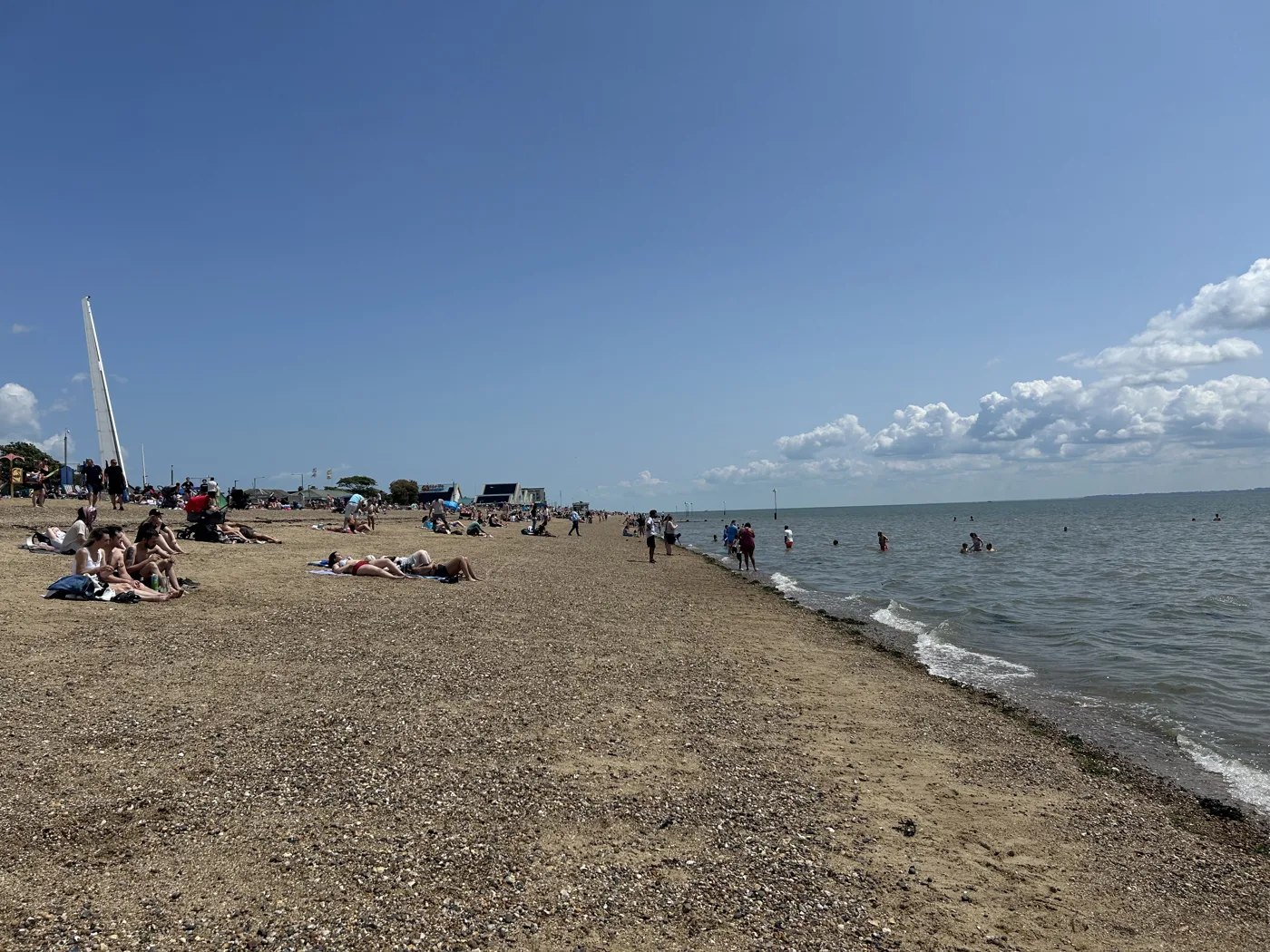

PC Tom Windeatt was dealing with an arrest when a teenager ran in shouting for help. Two minutes of CPR on Jubilee Beach, and the man started breathing again.
A police officer who was in the middle of dealing with an arrest left it, ran down to the water and pulled an unresponsive man out of the shallows at Jubilee Beach. He then gave CPR for about two minutes, until the man coughed up water and started breathing again.
Essex Police published PC Tom Windeatt’s account of the rescue on Friday 12 September (Essex Police). The force has not given a date for the incident itself, describing it only as part of the summer on Southend seafront.
The alarm came from a teenager who ran into the police base opposite the beach. “I need help, my mate’s drowning,” he said, according to the force’s account. PC Windeatt and PC Alfie Grodent ran down to the water and found a body face down in the shallows, with people around it trying to drag it out.
What happened on the sand
The force quotes PC Windeatt directly:
“I’ve gone in and pulled him up with the help of one of his friends and we’ve dragged him up further up the beach. The tide was coming in, and we needed time.”
“He was totally unresponsive. I thought he was dead. He’s not coming back. I was obviously really worried. We laid him out, and I did a primary survey of him and checked his breathing.”
Getting the space to work was part of the problem. The man’s friends were screaming around him, and the officers had to ask them to move back and be quiet so they could tell whether he was breathing at all.
He was not. PC Windeatt started CPR.
“I’d been doing it for around two minutes and then all of a sudden, he started to cough up water, we got a light pulse and then he started breathing. We put him in the recovery position and every breath more water was coming out, so we were very concerned for him.”
Other officers fetched a defibrillator and called the other emergency services. Paramedics and coastguards arrived, got the man onto a board and into an ambulance.
He was taken to the intensive care unit at Southend Hospital. The force says his chances looked bleak enough that Metropolitan Police officers were sent to bring his mother straight to his bedside. He spent two days in intensive care.
After he was moved to a ward, PC Windeatt went to see him.
“The doctors said he’s going to make a full recovery, which was great to hear. I stayed for half an hour and had a chat with him and his mum. They were both so grateful and relieved. Mum thanked me so much and we talked about how I wasn’t even meant to be there at the beach at that time. It was amazing, pure chance.”
The officer has stayed in touch with the family. The force says the young man is still shaken but continues to make good progress. He has not been named, and we are not naming him.
Southend District Commander, Chief Inspector Jane Childs, called the actions “exceptional”, and said the incident “is a reminder that policing is about far more than making arrests”. She added that Southend “has enjoyed a safe summer despite the significant demands that come with policing such a busy destination”.
Why the tide matters here, in numbers
“The tide was coming in, and we needed time” is the line in the account that a resident will recognise. Southend’s foreshore is wide, shallow and fills fast, and the numbers behind that are published.
The Port of London Authority’s predictions for its Southend gauge show how much water moves in a single tide here. On 12 September 2026, the day the force published the account, low water was 0.77 metres at 08:10 and high water was 5.96 metres at 14:06, British Summer Time. That is 5.19 metres in five hours and 56 minutes, or roughly 0.87 metres an hour, across seven miles of gently shelving sand and mud (PLA tidal information).
Across September 2026 as a whole, the daily range at Southend runs from 2.54 metres at the neap tide on 21 September to 5.70 metres at the spring tide on 12 September. Heights are metres above local chart datum, and these are astronomical predictions that assume average weather, so a surge moves the real level.
The practical point is that the distance between you and dry sand at Southend changes faster than it looks as though it should.
What it means for you
PC Windeatt used the account to give water safety advice, and it is worth repeating in his own words:
“If you’re going to enter the water, and especially if you’re not a strong swimmer, tell someone you’re going in, don’t go out of your depth, and definitely don’t drink alcohol before you go in. If you get into difficulty, float to live. Tilt your head back, try to relax, and use your arms and legs to stay afloat.”
That last part is the RNLI’s Float to Live technique, which Southend-on-Sea City Council promotes as part of its own coastline safety advice. The council says the campaign has helped save more than 50 lives (Southend-on-Sea City Council).
What else is in place along the seven miles of coast, per the council:
- a Foreshore Patrol Team that patrols the beaches and seafront on foot and by vehicle during the season
- beach safety signage and emergency-only telephones
- first-aid trained officers
- partnership working with the RNLI, HM Coastguard and the emergency services
If you are on the beach and someone is in trouble in the water, call 999 and ask for the coastguard. The same estuary conditions were behind the ex-lifeboat left aground on the mudflats earlier this month. If you are heading to the seafront, our things to do in Southend guide and our parking in Southend guide have the practical details.
Sources
- Essex Police: “He was totally unresponsive. I thought he was dead” - PC saves the life of drowning man, published 09:00 on 12 September 2026. All quotes in this article are from that statement.
- Port of London Authority tidal information and the authority’s published tide predictions for the Southend gauge
- Southend-on-Sea City Council: reminder to stay safe on Southend’s coastline, for the Foreshore Patrol Team and the Float to Live campaign
Have your say