
Councillors refused 2,000 Green Belt homes on 27 August. Officers want the reason reworded on Counsel's advice, warning extra reasons risk a costs award.
Southend’s planning committee threw out 2,000 homes on Green Belt farmland three weeks ago. Tonight it is being asked to say it again, in different words.
The committee meets at 5pm on Wednesday 16 September in Committee Room 1 at the Civic Suite, and application 25/01792/OUTM has been added to the end of the agenda as an urgent item. The Chair agreed to take it under section 100B(4)(b) of the Local Government Act 1972, on the grounds that “a decision was required and delay would prejudice the effective discharge of the Council’s planning functions” (agenda, Southend-on-Sea City Council).
It is not in the main plans report, which carries five other applications. It arrived in a separate supplementary pack.
The scheme, by Thorpe Estates Ltd, is for up to 2,000 homes north of Bournes Green Chase in Southchurch ward, including up to 150 later living units, a two form entry primary school, nursery provision for up to 106 children, a local centre and a public park of at least 23.28 hectares. Officers had recommended approval. We covered that recommendation, and the 315 objections against it, in our report before the August meeting.
Members disagreed. On 27 August the committee resolved that planning permission be refused, for a single reason built on Green Belt harm (minutes of the meeting held on 26 and 27 August).
What happened after the vote
The council’s own account is unusually candid. The 27 August resolution “has been the subject of extensive discussions and correspondence between some elected members and the Council’s legal team”. Independent legal advice was then sought from Counsel “to clarify the relevant legal and procedural considerations” (supplementary report).
Officers now recommend changing the wording “to improve the precision and robustness of the draft reason for refusal”. Because the resolution has already been passed, only the committee itself can amend it.
The words that change
The differences are small on the page and large in law. Compared with the reason members passed in August, the new wording:
- says the benefits do not clearly outweigh the harm, rather than simply do not outweigh it
- adds that the harm is by reason of inappropriateness and other harm
- recasts the farmland and affordable housing points as other harm, rather than as free standing findings
- adds Core Strategy Policy CP5 to the list of policies breached
- refers to the Green Belt and other policies of the National Planning Policy Framework, not the Green Belt policies alone
Those phrases are not decoration. “Clearly outweigh” and “inappropriateness and any other harm” are the language of the very special circumstances test a planning inspector would apply on appeal. The August wording did not track it.
A second reason, and the money behind it
Officers also recommend adding a second reason for refusal: that no section 106 legal agreement has been completed, so the obligations needed to make the scheme acceptable are not secured.
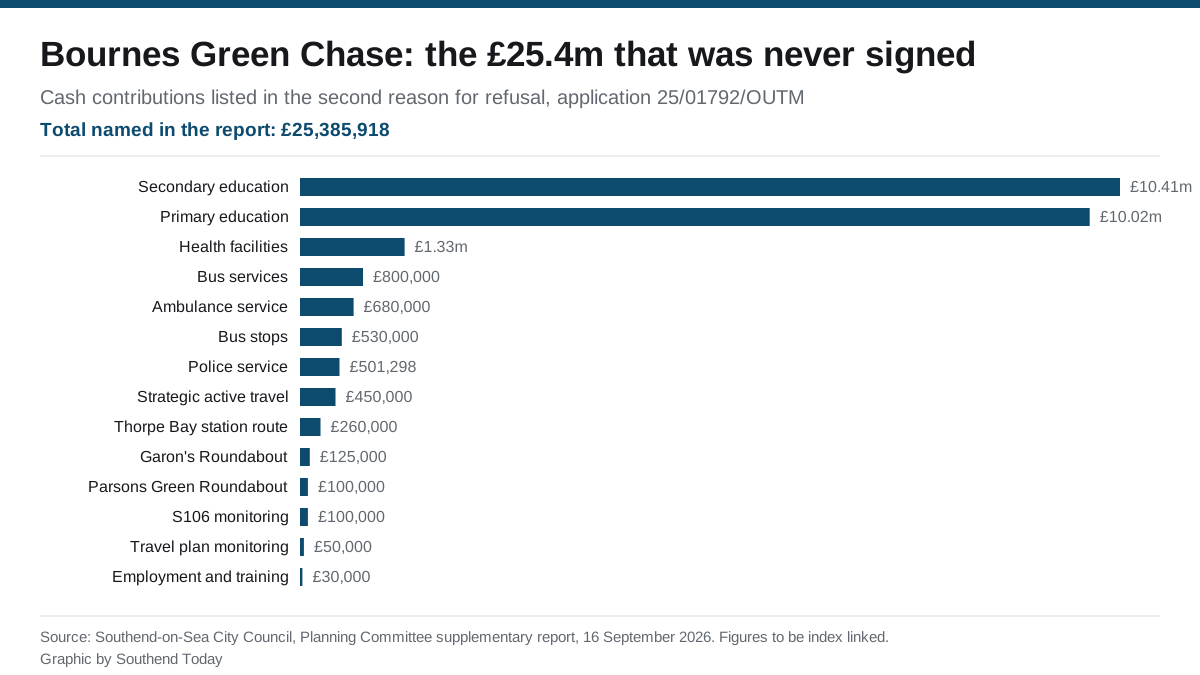
That reason has to list what those obligations were, which is why the report sets out the package the developer had agreed to. The cash contributions named in it add up to £25,385,918, on our own arithmetic from the figures in the report. Education takes four fifths of it.
| Contribution | Amount |
|---|---|
| Secondary education | £10,408,320 |
| Primary education | £10,023,300 |
| Health facilities | £1,328,000 |
| Bus service enhancement and rerouting | £800,000 |
| Ambulance service | £680,000 |
| Bus stop enhancement | £530,000 |
| Police service | £501,298 |
| Strategic active travel | £450,000 |
| Thorpe Bay Station active travel route | £260,000 |
| Garon’s Roundabout | £125,000 |
| Parsons Green Roundabout improvements | £100,000 |
| Section 106 monitoring | £100,000 |
| Travel plan monitoring | £50,000 |
| Employment and training | £30,000 |
All of it was to be index linked. Alongside the money, the agreement would have required:
- a minimum of 45% affordable housing, split 60% affordable rent and 40% shared ownership, with key worker housing making up a quarter of both
- a serviced two form entry primary school site handed to the council at nil value
- a health facility site, also at nil value
- a not for profit stewardship body to run the strategic open space and community assets
- Suitable Alternative Natural Greenspace managed and maintained for at least 80 years
- a minimum of 15% local labour and 15% local procurement during construction, and 20% local labour in the finished commercial units
None of that is secured, because the agreement was never signed.
The warning about costs
Some members had proposed further reasons for refusal after the August vote. Officers do not recommend including them, because doing so “may increase the risk of an award of costs against the Council in the event of an appeal”.
That is the practical stake tonight. If the developer appeals and wins, and an inspector finds the council behaved unreasonably by refusing on grounds it could not defend, the council can be ordered to pay the developer’s costs. The refusal itself is not in question. What officers are trying to protect is the council’s position if the decision is tested.
The Secretary of State already knows
Because this is a major residential scheme the council is minded to refuse, the August resolution was referred to the Secretary of State, as required. Any fresh resolution tonight will be referred in the same way.
Officers are also asking members to delegate the final refusal to senior planning staff, to be issued only after that consultation and only if no direction is issued under section 77 of the Town and Country Planning Act 1990. Section 77 is the power to call an application in and decide it nationally instead. Until the Secretary of State declines to use it, the refusal cannot be formally issued.
One oddity worth noting: the supplementary report is headed “Planning Committee 13th September 2026”, while the agenda it belongs to is dated 16 September. The August minutes also cite the consultation direction as the 2026 version, where the supplementary report cites 2024.
What it means for you
- Nothing about the site changes tonight. The refusal stands either way. The question is only how it is worded, and whether it survives an appeal.
- The decision is still not final. It cannot be issued until the Secretary of State has been consulted and has decided not to call the application in.
- An appeal is the realistic next step, and the whole point of tonight’s rewrite is that appeal. Watch for an appeal lodged with the Planning Inspectorate rather than for anything further at the Civic Suite.
- You can watch. The meeting is webcast from the committee’s agenda page, and the papers are published there in full.
- To follow the application, use reference 25/01792/OUTM on the council’s planning portal. Our guide to Southend planning applications explains how the process works and what each stage means.
Sources
- Planning Committee agenda, 16 September 2026, Southend-on-Sea City Council
- Supplementary report, application 25/01792/OUTM, Southend-on-Sea City Council
- Minutes of the Planning Committee, 26 and 27 August 2026, Southend-on-Sea City Council
Have your say